

Time to Get In the Way of Something
Effort, Instinct and Sentimental Value

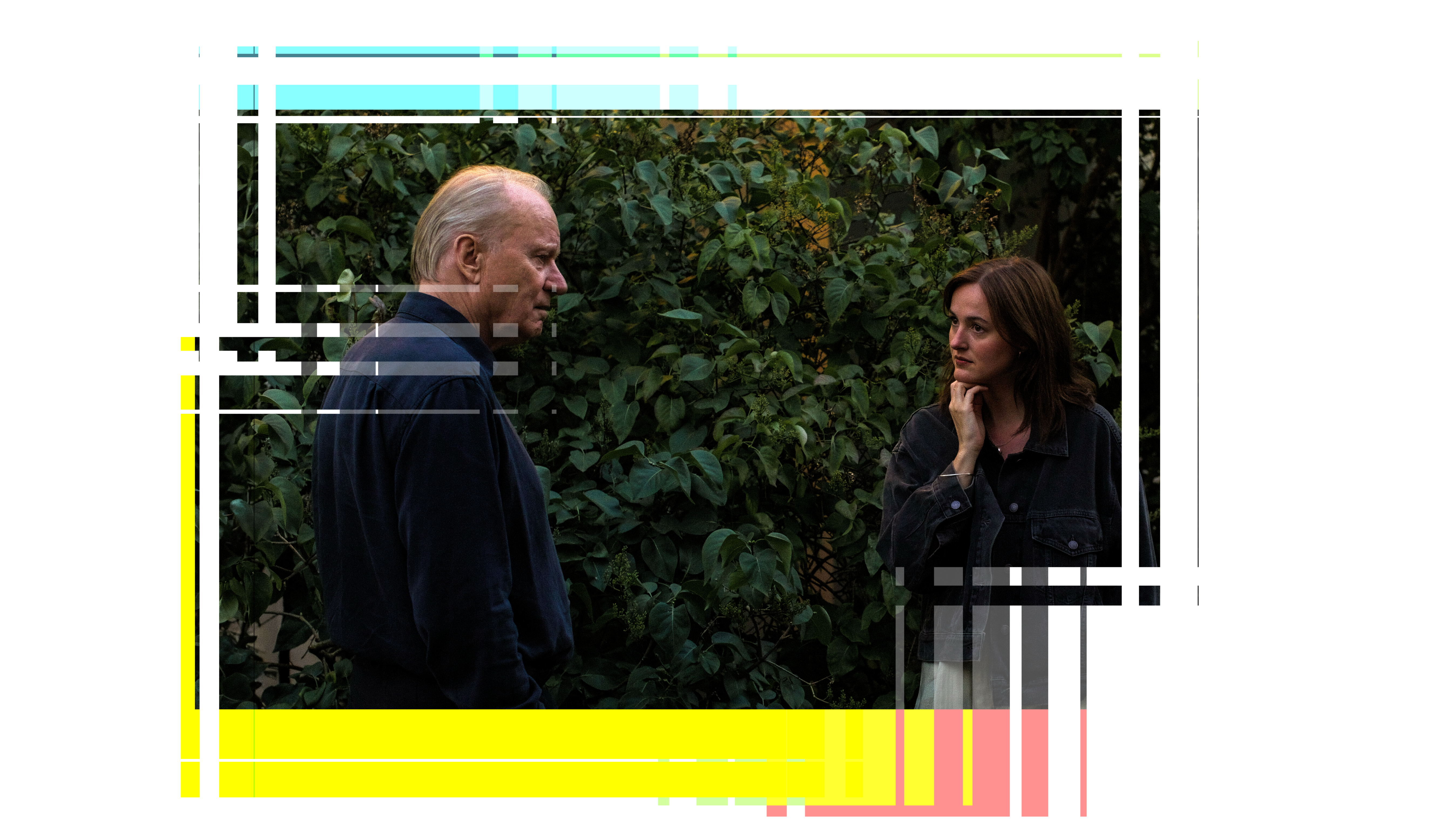
I think it’s time more movies did this — how hard is it to do one thing at a time? To get out of the camera’s way? To let it do exactly what it wants to do? Mr. Joachim Trier definitely knows how to get out of Stellan Skarsgard’s way (or, at least, he knows that he needs to) — the lifelikeness of Skarsgard’s Gustav is so striking and apparent, we barely register the garish scenery, the perfect clouds, the sunset sky, the sand, the ocean and all the rest, nor do we notice how odd it is to hail a horse-drawn chariot pick you up right on the shoreline, practically in the shorebreak.
The garishness of his life is so clearly Gustav’s element. It’s his natural habitat. He will endure leaving it for almost nothing — certainly not his children. But fatherhood requires nothing from the father. The only other father in the movie is hardly there even when he’s present. He’s inattentive, buried in a phone, or asleep in bed, turned away. We’d be forgiven for forgetting he’s even got a few lines. No, fatherhood is something everyone needs except the father. And everyone has to earn their keep to get it out of him, if they can even be bothered to try.
Renate Reinsve’s enigmatic Nora, Gustav’s oldest daughter, is the movie’s engine, feeling everything at the wrong time, feeling nothing when other’s feel something, feeling anger when other’s don’t want her to, feeling in love but only when it’s too late. Acting — playing the role of some other person, anyone but herself — is how she connects to her own life. She seems more herself in moments of spite for Gustav, moments of opposition to him, but even that he can take away.
Gustav says he sees himself when he looks at Nora — not a daughter, but his reflection — and he sees anger. If that’s true, where does it go? Where does hers go, and where does his? On the one hand, Gustav sees himself only in the displacement of others. On the other, his displacement of Nora’s identity is the only way Nora knows it exists. Displacement defines him and it defines her. Nora even has to be reminded of all the ways she had cared for her younger sister, Inga Lilleaas’ Agnes, in their empty childhood — she listens to a story of herself she’d completely forgotten, like she wasn’t even there for it, as remote and removed from her own life as her father had been.
Elle Fanning’s Rachel ultimately steps away from the role Gustav intended for Nora, unable to reconcile the displacement of identity and lack of understanding that make up this family’s default state. Rachel is hardly to blame, Gustav tells her, and we know he’s right. Not even Nora can be Nora — Rachel could never stand in for Gustav’s daughter without disappointing him at every turn. But if Nora could play the role of herself, two things could be true at once — return to self and displacement of self.
It’s a contradiction, but it works, and as such the movie’s final moments are not so much of reconciliation as they are of recognition. Through Nora’s final performance of self, both she and Gustav have finally seen who Nora is — what the father gave up, and what the daughter has been missing, in no small part, because of him. There’s more life to be lived, at least for one of them, and less and less room for anger — that’s where it goes, it’s let go, it has to be. Then the film ends — with the strum of a rom-com guitar?
Despite the movie’s excellence, there’s something Trier can’t seem to do. It’s not in the writing. It’s not in the performances. It’s not in the presentation either — even the chapteresque cut-to-blacks of the edit, which do not come from the screenplay as far as I know, feel like an embrace of the seams of a movie discovered later in the process, little pauses like the turning of a page, like maybe the movie we’re watching, impossibly, is Gustav’s movie which Nora and Agnes are flipping through.
At its best, we can never tell where Sentimental Value’s self reflexivity ends and begins. But Trier’s instincts to get out of the movie’s way, ultimately, betray him. At its worst, Trier never finds the right time to step on the stage himself, to put his hand on the scale, to take out the banal fucking guitar bits at the start and finish and throughout, to tighten the ending, to raise the stakes, to be bold, to finally get in the way of something.
My primary motive in seeing his movie was actually the one and only Hania Rani, Trier’s composer, whose hauntingly inevitable wind-piano-synth original score would be the envy of any project. Yet Trier never lets Rani roam free, he works in very few of her original tracks, returning seemingly to the same one over and over, and skipping around the others. The most salient piece of music on the soundtrack, named for Gustav himself, the movie abandons. I’d been so excited to discover how Rani’s work would be used in the movie, and the answer is it hardly was.
The audience deserves conviction. Trier speaks of the ending in interview with Vanity Fair’s 2025 Cannes Film Festival Coverage, as a meeting between two people so alike and yet so different, where father and daughter are impossible to reconcile, and where that’s okay. Why then do Vanity Fair and others characterize the ending as a reconciliation? It may be because reconciliation is an easy word, and plausible enough. It may be because Trier doesn’t have what it takes to prevent the tonal blurring of his movie, nor the conviction to propel it into the hearts of the audience in the way his cast deserves. At any rate, he’s fortunate that it doesn’t matter, because Reinsve, Skarsgard, Fanning and Lilleaas succeed, and the movie succeeds because of them.